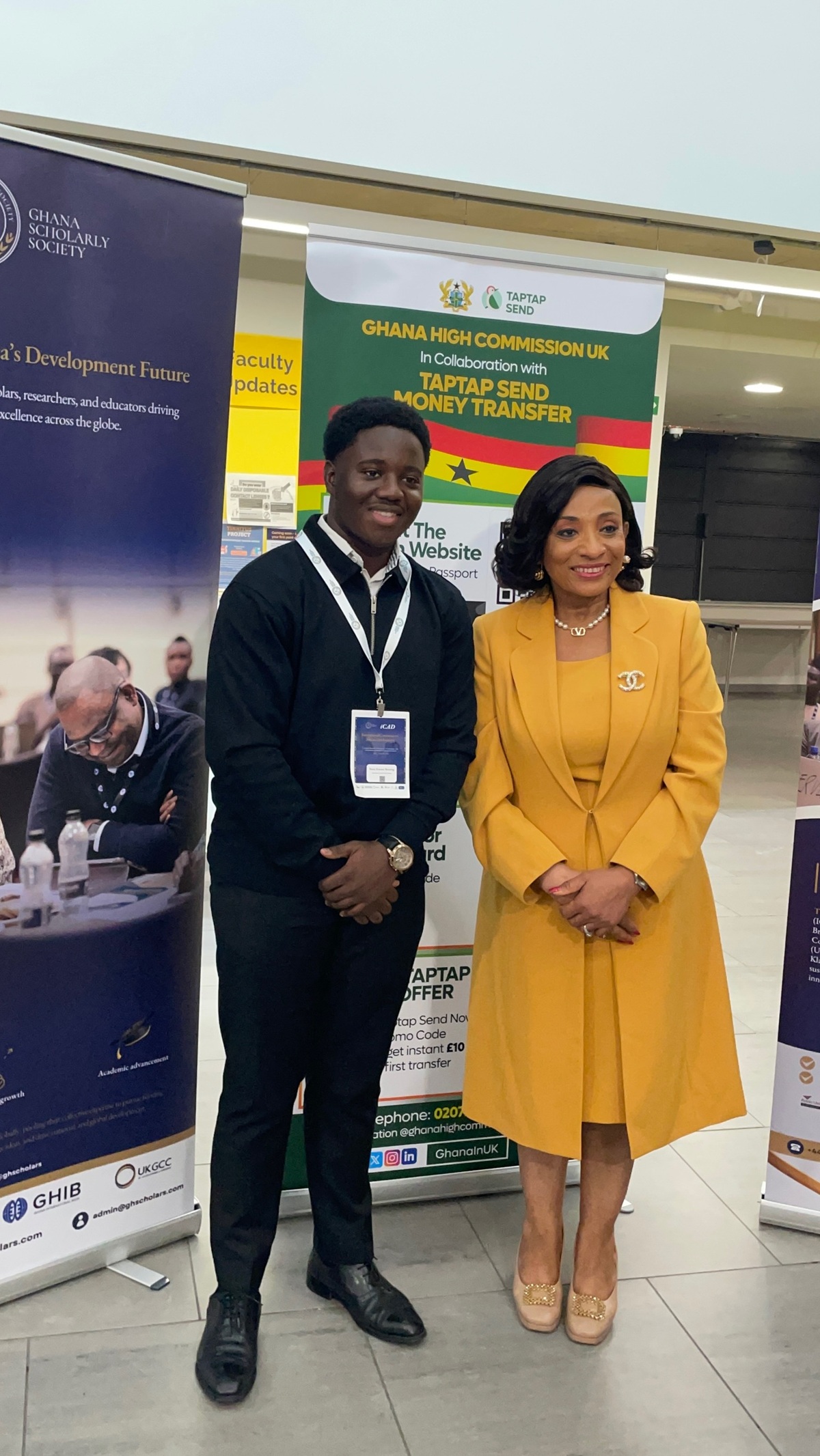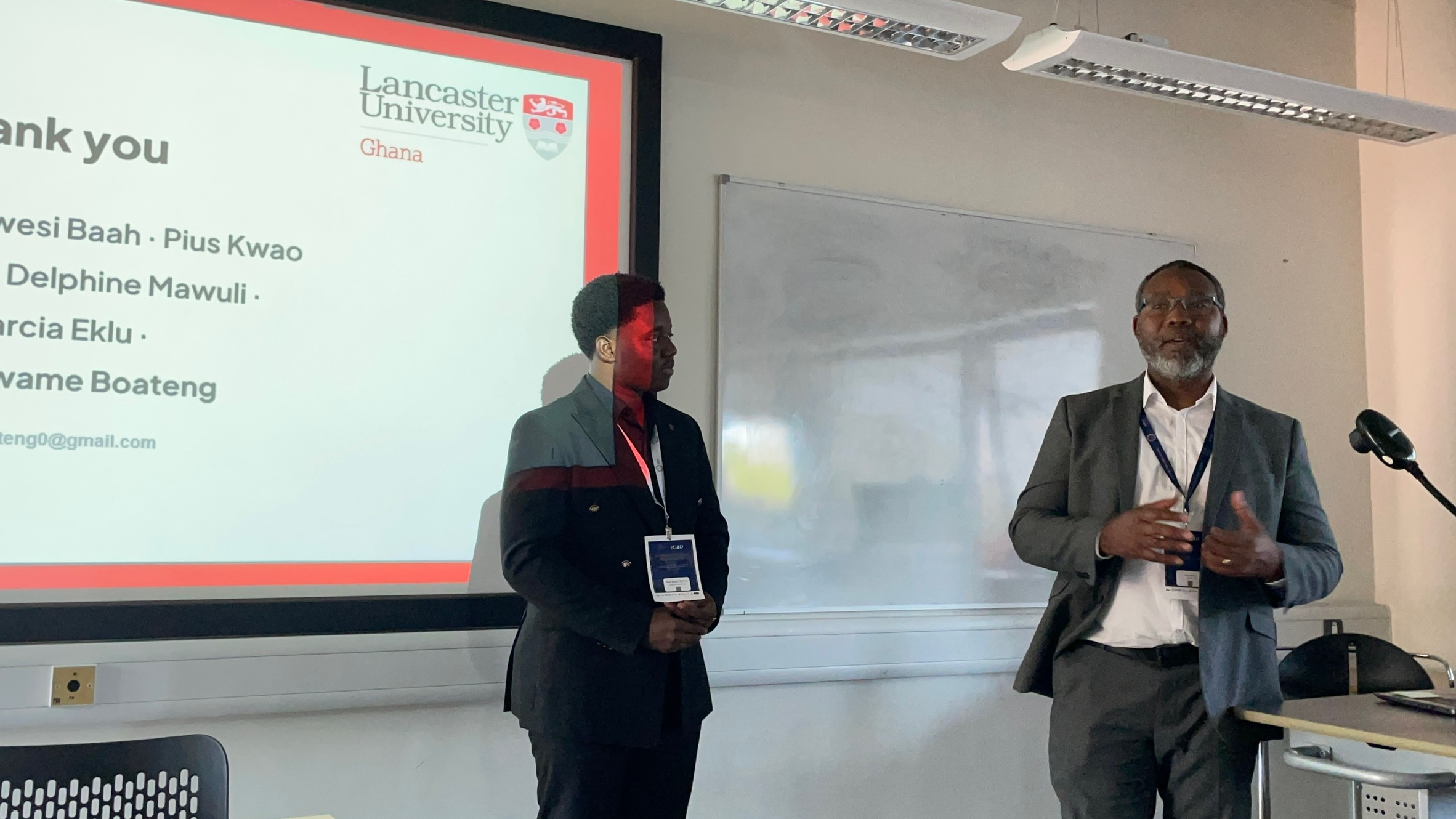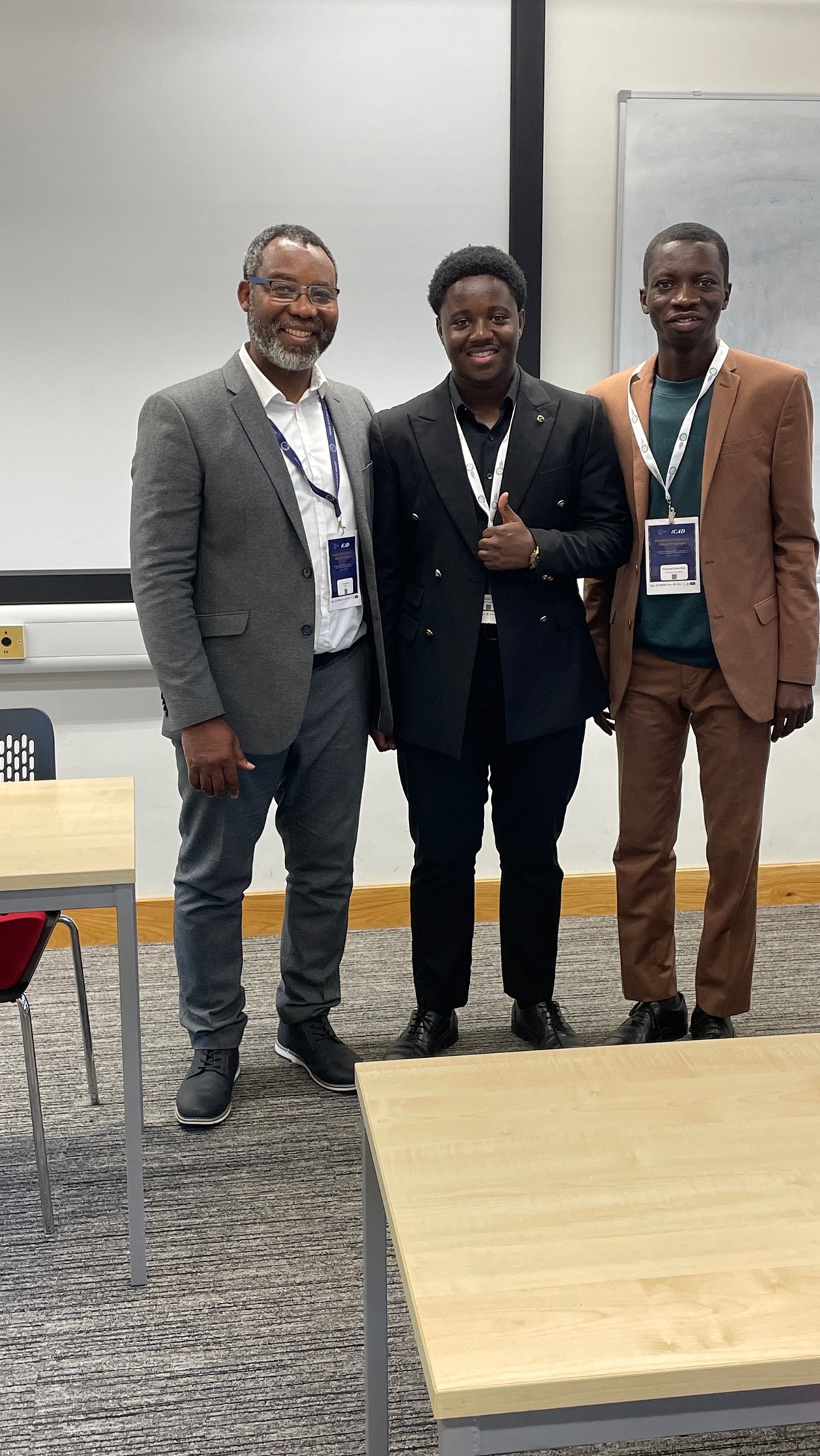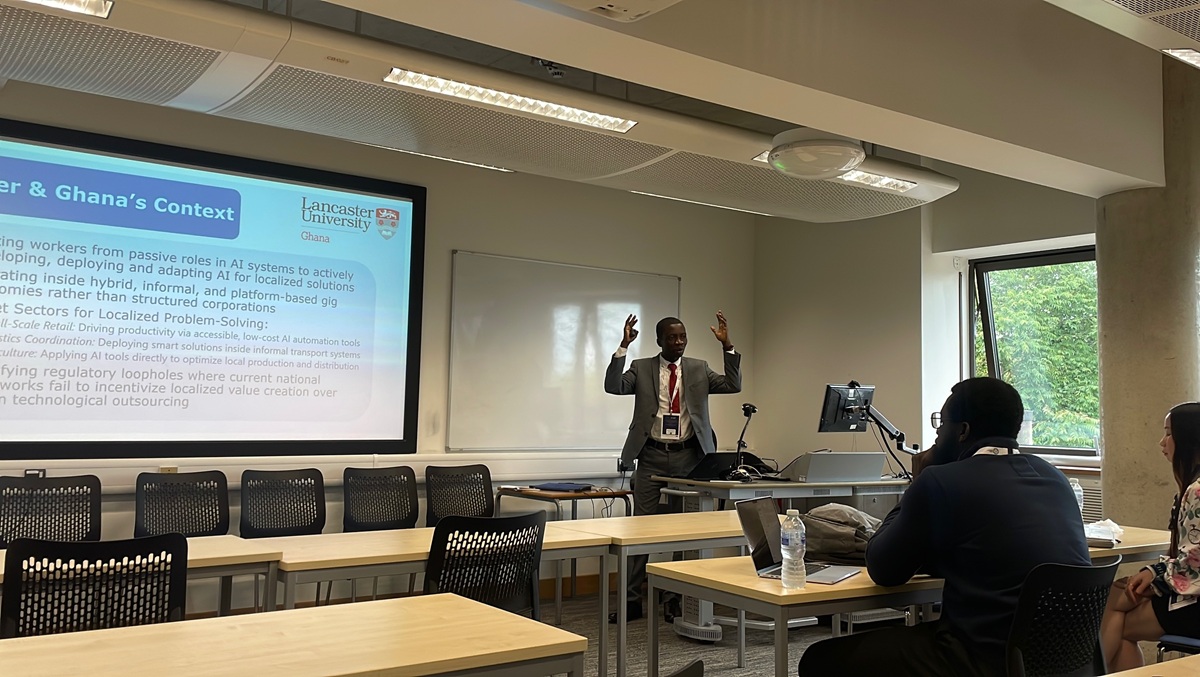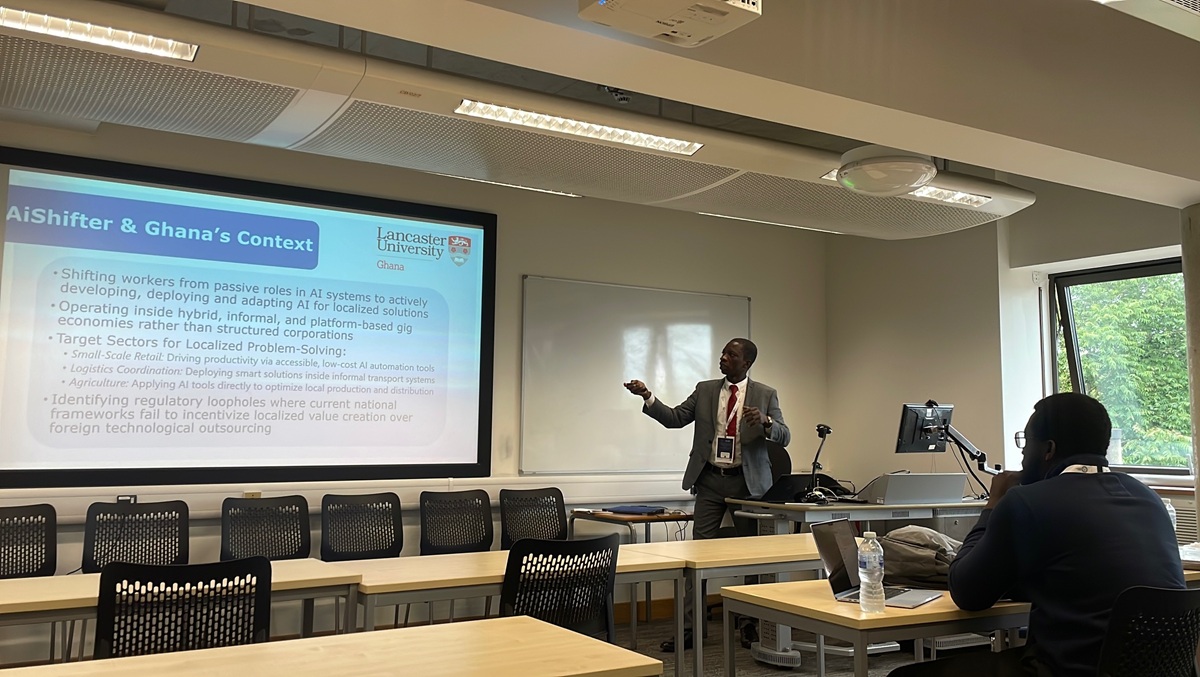
Lancaster University Ghana demonstrated its growing research excellence at the 2026 International Conference on African Development (iCAD 2026) held at Anglia Ruskin University in Cambridge, United Kingdom, where lecturer Emmanuel Baah and undergraduate student Nana Kwame Boateng presented original research exploring how artificial intelligence can address Africa’s evolving workforce and productivity challenges.
The conference brought together academics, researchers and policymakers from around the world to explore innovative solutions to Africa’s most pressing development issues. Among the presenters, Nana Kwame stood out as the only undergraduate student presenting alongside postgraduate researchers and doctoral scholars, highlighting Lancaster University Ghana’s commitment to nurturing research talent at every stage of the academic journey.
Emmanuel Baah, a lecturer in the University’s Department of Computer Science, presented his research, “AiShifters: Conceptualising the Future Workforce for AI and Automated Industries in the Global South: A Case Study of Ghana.”
His research challenged the dominant narrative that artificial intelligence will inevitably lead to widespread job displacement. Instead, it proposed the AiShifter Framework, which positions AI as a tool for augmenting human capability while enabling African countries to develop locally relevant solutions.
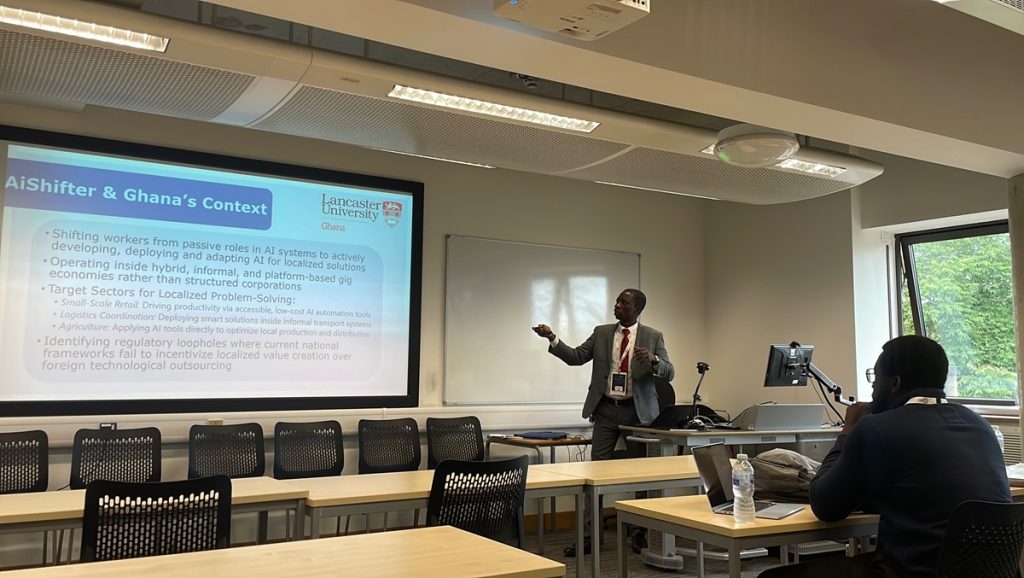
The framework advocates greater investment in digital infrastructure, workforce reskilling, local AI innovation and sovereign AI systems that respond to Africa’s unique socioeconomic realities. It also calls on policymakers to move beyond preparing workers for outsourced digital labour and instead invest in building indigenous AI capabilities that drive long-term economic transformation.
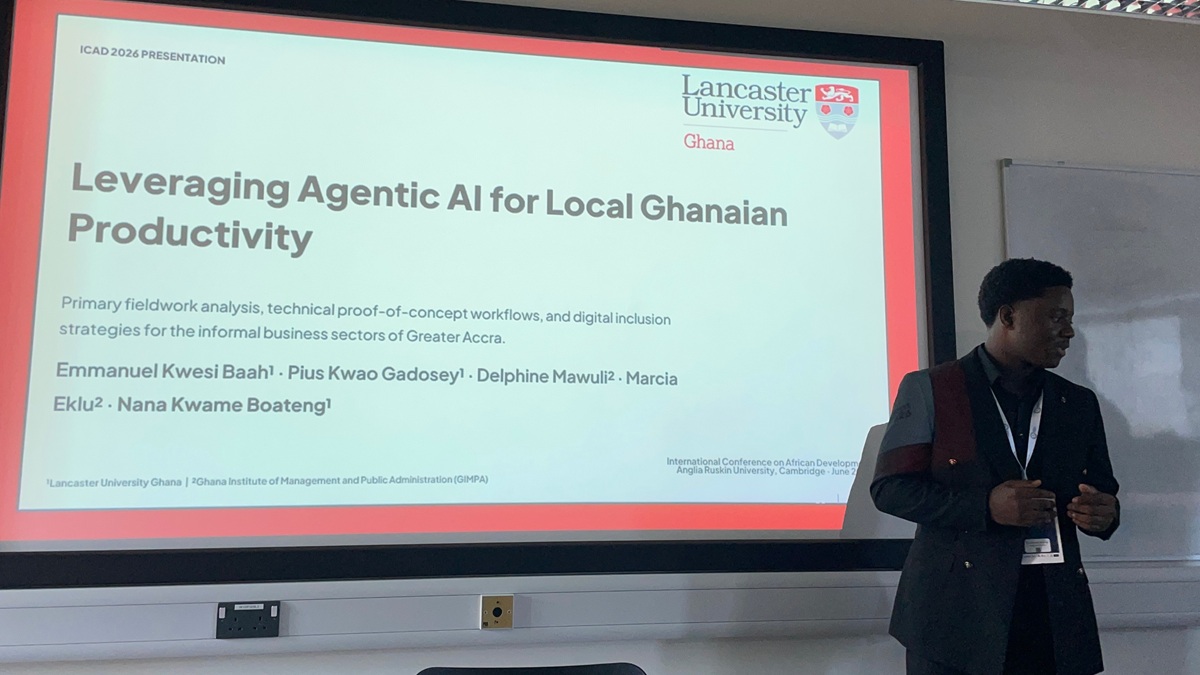
Complementing this research, undergraduate student Nana Kwame Boateng presented “Leveraging Agentic AI for Local Ghanaian Productivity,” demonstrating how autonomous AI systems can improve productivity for Ghana’s small and medium-sized enterprises (SMEs).
Recognising that SMEs account for approximately 92% of businesses in Ghana and contribute around 70% of the country’s GDP, the research examined the practical barriers preventing businesses from adopting AI technologies. Through 114 qualitative interviews with retailers, service providers and small-scale manufacturers across Greater Accra, the study found that affordability, digital literacy, trust and language localisation remain significant challenges.
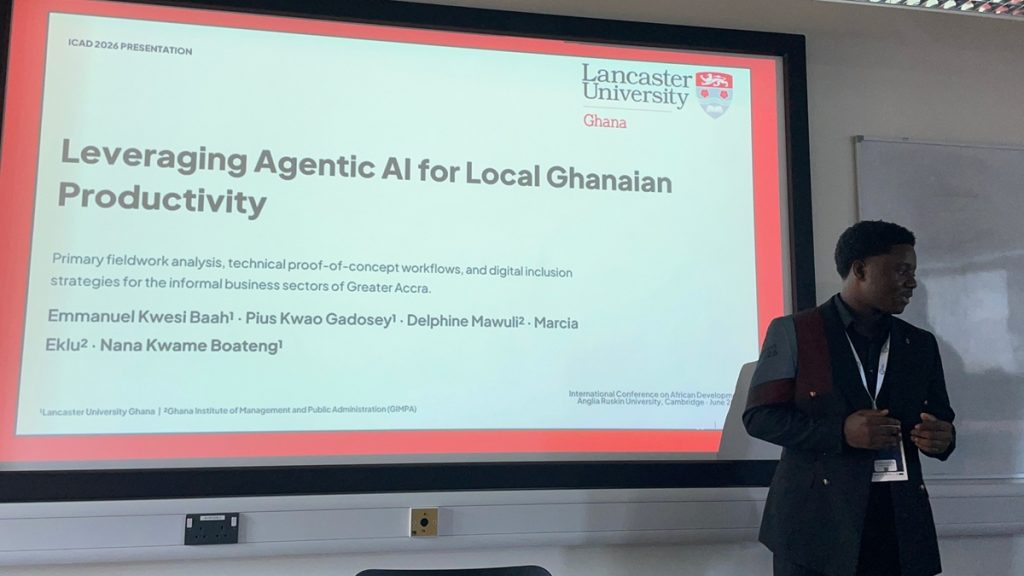
Rather than presenting purely theoretical concepts, the research introduced a working proof of concept built using open-source AI frameworks. The proposed solution demonstrated how agentic AI can automate routine administrative tasks such as responding to WhatsApp enquiries, verifying customer information, generating summaries, updating databases and monitoring inventory, allowing businesses to reduce repetitive manual work and improve operational efficiency.
A key finding highlighted the importance of designing AI systems around African realities. While standard English interactions produced reliable results, performance declined when users naturally switched between English, Twi, Ga and Ghanaian Pidgin, reinforcing the need for local language AI models that are inclusive and accessible.
The research concluded that AI’s greatest opportunity in Africa lies not in replacing workers but in reducing repetitive administrative tasks, enabling businesses to become more productive while keeping people at the centre of decision-making.
Together, the two presentations reflect Lancaster University Ghana’s commitment to research that addresses real-world challenges while contributing to Africa’s sustainable development.
By exploring both the future of AI-enabled workforces and the practical application of AI within local businesses, Emmanuel Baah and Nana Kwame Boateng demonstrated how research from Lancaster University Ghana is contributing to conversations that shape technology, policy and economic development across the continent.
Their participation at iCAD 2026 not only showcased the quality of research emerging from the University but also underscored Lancaster University Ghana’s dedication to developing both academics and students who are equipped to contribute meaningfully to global knowledge and innovation.